
Solar has mostly won the argument on cost. The argument it keeps running into now takes place in the village hall.
When a developer turns up with plans for a new park, the questions from locals are rarely about levelized cost of energy. They want to know what happens to the land, the water and the view. In one Bulgarian case, residents of four villages petitioned against a proposed park, warning of economic and demographic collapse.
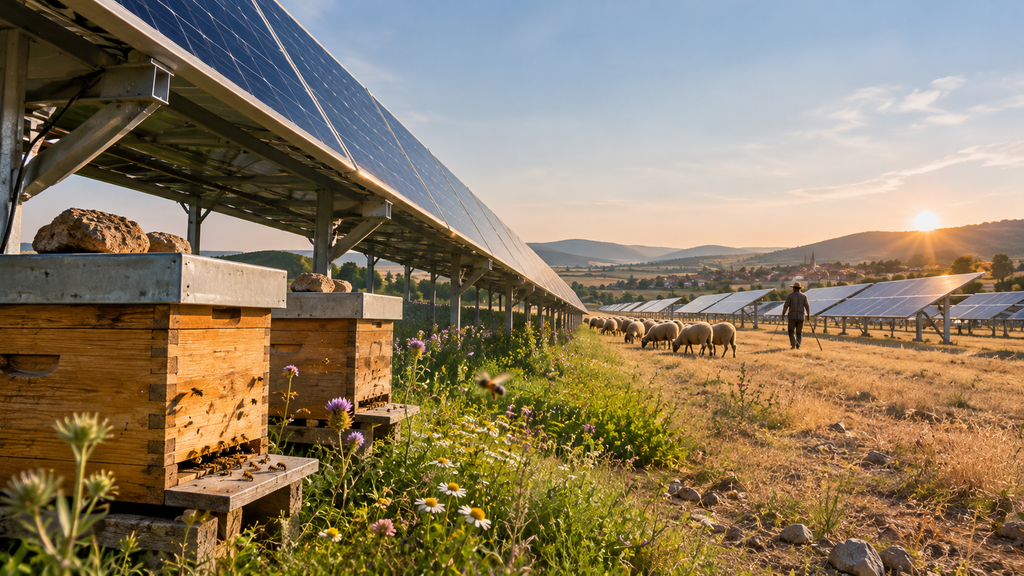
Sofia-based Pollenity thinks part of the answer is a beehive. Its subscription product, EcoPulse, places hives inside solar parks and uses the bees as living environmental sensors. Operators get hard data on what is happening on their land, and the community gets a neighbor who can explain it.
The customers came back for more
EcoPulse already runs in parks operated by solar companies Sunotec and Enery. The telling detail is what happened after the first year: having seen the results, both clients doubled their number of sites.
Environmental monitoring is often treated as a line item for the sustainability report. Doubling down after a year suggests these operators see something more useful than that.
Panels on poor land, shade on parched ground
Pollenity’s thesis starts with where solar parks are allowed to go. In its home market of Bulgaria, the rules steer them away from productive farmland. In 2025 the Constitutional Court threw out a relaxation of those rules, and the national photovoltaic association says existing parks sit on land unsuitable for farming.
That land is often exposed and baked by the summer sun. Put panels over it and the energy that would have scorched the plants goes to the grid instead. The ground underneath gets shade, and the vegetation gets a break.
The research points the same way, with caveats. A study at an Oregon solar plant found partial shade delayed bloom and increased flowers late in the hot, dry season, just when pollinators need forage most. A UK modeling study found twice as many bumble bees in parks managed as wildflower meadows as in those with only wildflower margins.
But US researchers studying sites in Minnesota warn that effects vary with landscape and climate. So an operator can’t simply assume its park is helping. It has to measure, which is where the bees come in.
A sensor that flies
A colony works like a distributed sampling network. Its foragers cover the park and the land around it every day, then bring pollen and nectar back to one place. Analyze what they collect, season after season, and you get a running picture of what is growing there.
Pollenity says it has seen the shade effect play out in the parks where it operates, with hive data showing plant life benefiting from the protection of the panels. For an operator, that turns a sustainability claim into a dataset.
Winning over the neighbors
The data matters most to the people who never asked for a solar park. Many rural communities are fearful of the technology and skeptical of the companies building it, and glossy brochures do little to change that.
Evidence collected on site, over years, is harder to dismiss. A beehive is also something people understand. A farmer may not care about inverter uptime, but they know what healthy bees and flowering land look like.
For green energy, that is a practical problem as much as a PR one. Public opposition can stall a project, and every park that becomes a credible local success makes the next conversation easier.
The playbook for a better solar park
Pollenity’s advice to operators goes beyond installing hives. Its recommended practices treat the park as working land rather than a fenced-off asset:
- Invite the local herds. Animals grazing between the rows keep vegetation in check and carry seeds from plot to plot, which promotes biodiversity. Herders also gain access to new pasture, a direct economic benefit for the community.
- Manage the ground for flowers. Lighter mowing and diverse planting give pollinators more to work with, and the UK research suggests management is a major driver of the results.
- Hire a local beekeeper. Each beekeeper is trained in the program and fairly paid for the work. They also become something no communications team can buy: a trusted local who has seen inside the fence and can vouch for what is happening there.
- Measure it all. The hive ties these practices together. If grazing and lighter mowing are enriching the land, the change should show up in what the bees bring home.
An early-warning based on “nature’s autonomous drones”
The same sampling network can also pick up what operators would rather not find. Bees come into contact with plants, water and air across a wide area, so what they carry home can reveal chemicals and contaminants in the surrounding environment.
That gives EcoPulse a second job. Alongside tracking biodiversity, it helps operators promote sustainable land use and spot pollution, including problems that start beyond the park’s fence.
Bees won’t end every fight over a solar park. But they can give both sides of that fight the same set of facts, and for an industry that needs local permission to keep growing, that may be worth paying for.
Content is provided for informational purposes. Findings from individual monitoring programmes should be interpreted in the context of their methods, sampling scope and limitations.