
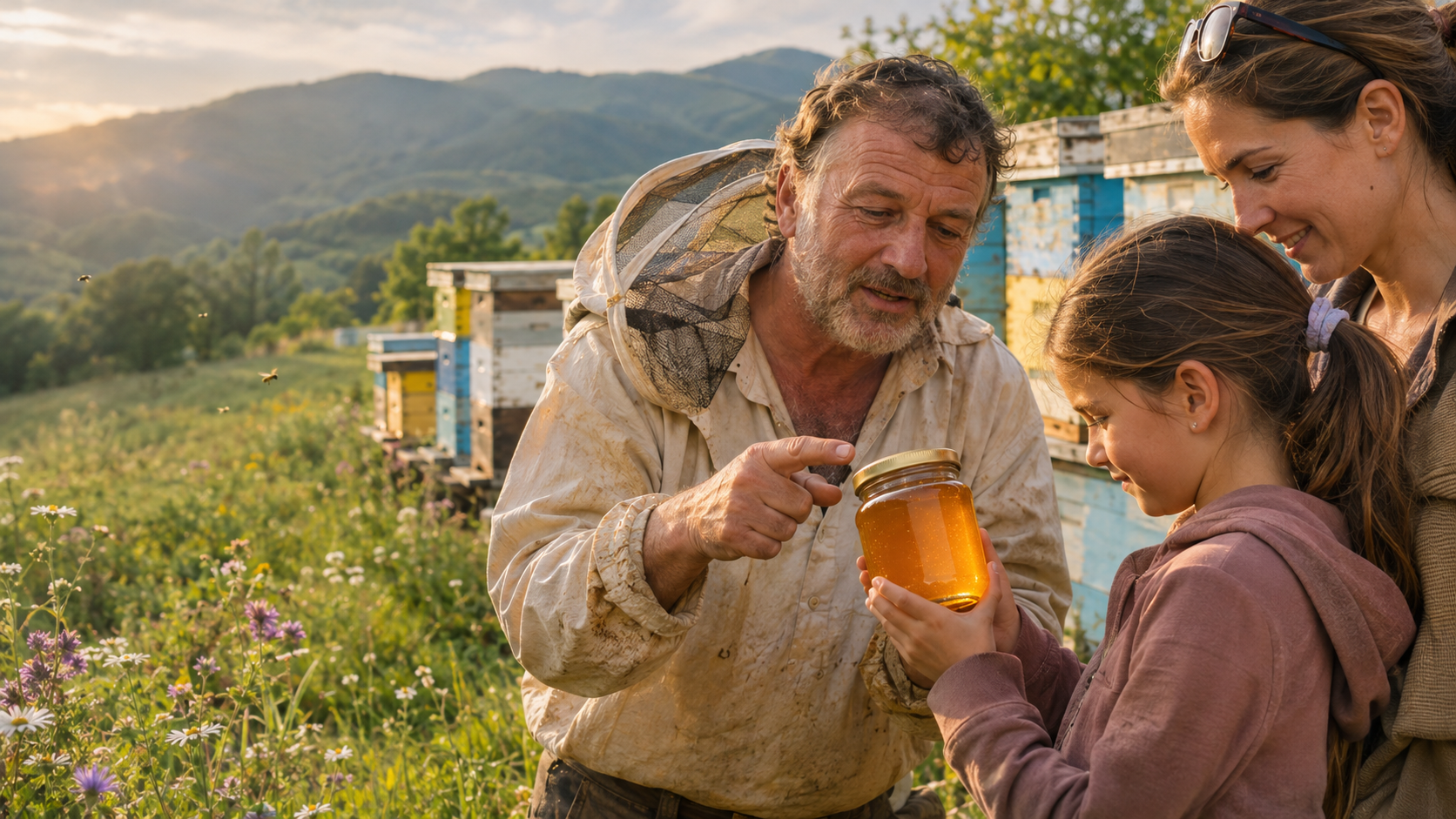
We don’t claim to have fixed Bulgarian beekeeping. But after years of trying, and getting a lot wrong, we believe we have found a model that works for the people who keep bees and the people who eat honey. This is the story of how Genuine Honey (Истински мед) came to be.
Two sides of one broken market
The problem we kept running into had two sides, and they fed each other.
On one side were the beekeepers. Many were selling their honey to middlemen for as little as 3–4 leva per kilo (about €1.50–2). That is a price that doesn’t reward a year of hard work, and it gives nobody a reason to look after their colonies better or to bring a son or daughter into the craft.
On the other side were the families buying honey. Many of them simply didn’t trust what was on the shelf. They wanted real honey but had no way of knowing where a jar came from or who had made it.
So good beekeepers couldn’t reach the people who would value their work, and those people couldn’t find them. Genuine Honey exists to close that gap.
We started with technology, and it wasn’t enough
We didn’t begin as a honey company. We began in 2014 with a prototype and a conviction that sensors could save bees. In 2015 we founded Bee Smart Technologies and built Beebot, a device that tracks temperature, humidity and the sound of a colony in real time.
We are still proud of that work. Beebot reached beekeepers on five continents. But we eventually had to admit something uncomfortable: it wasn’t solving the problem we had set out to solve. The commercial beekeepers we built it for didn’t adopt it, and better data doesn’t help much if the honey still sells for 3–4 leva a kilo.
That could have been the end of the story. Our passion for bees and the people who keep them made us continue, but we had to change how we worked.
We turned to academia, and joined HIVEOPOLIS, a European research consortium with six universities. Working alongside scientists taught us how much we still had to learn. We also turned to what we had right here at home: our knowledge of Bulgarian beekeeping, and the relationships we had built with beekeepers across the country.
Those two things became the base of Genuine Honey. In December 2019 we launched Adopt a Hive, and the honey business grew from there. The technology didn’t disappear. It found its proper place, serving the model rather than being the model.
An honest price and a shorter road to the table
The model is simple: buy directly from beekeepers at a better price, check the honey, and bring it to people with as few steps in between as possible.
We set out to pay above the market. In 2022, for example, our purchase price was 22% above the official national price, or 1.69 leva (about €0.86) more per kilo. It is not charity. Beekeepers deserve to earn a living from good work, and a stable income lets them invest in their colonies.
The road from hive to home now looks like this:
- A beekeeper we know, and whose name stays attached to the honey, supplies a batch.
- We have the batch tested for quality in a laboratory.
- It is packed by our production partner, with capacity for up to 1,700 jars a day.
- It goes to customers through our online shop, our subscriptions, our store on Cherni Vrah Boulevard in Sofia, or directly to companies.
Every step we removed was money and trust that used to get lost along the way. We can now draw on more than 100 Bulgarian beekeepers, and through Adopt a Hive more than 5,000 families have chosen to support one directly.
Leading by example, as best we can
We can’t ask a whole sector to change by telling it what to do. All we can do is work in a way we’d be happy for others to copy, and be open about it. That means publishing who made the honey, testing it, and paying properly.
It also means giving back where there is no commercial return. Through the Istinski Med Foundation we donate equipment, help beekeepers restore their winter losses, and collect swarms from cities.
Honey in place of sugar
Children eat far too much refined sugar, and we would like to help change that. We encourage families to replace some of it with real honey, and our range includes honey-based products such as Plodomed and Shokomed as alternatives to the usual sweet snacks.
We want to be careful here. Honey is still a sugar, so the idea is a spoon of honey instead of a spoon of sugar, not on top of it. And honey should never be given to babies under 12 months.
Education for everybody
A child who has met a beekeeper tends to look at a jar of honey differently, and so does an adult. That is why we teach anyone who wants to learn:
- Children: our Foundation’s beekeepers visit kindergartens and schools in Sofia, Pernik, Trastenik, Shumen and Aytos, with funding from Ficosota, APIVITA and private donors. We aim for at least 100 visits this school year, and we pay the beekeepers for each one.
- Future beekeepers: in 2022 we offered a three-month course with 30 places, and nearly 300 people applied in two weeks. It became our Beekeeping University.
- Families: for five years, World Bee Day on 20 May has brought thousands of people to our family festival in Sofia.
- Colleagues and teams: companies bring their people to the apiary to see the work up close.
Trying not to waste
We try to use materials carefully, and the model helps. Fewer steps mean less handling and transport, and because many customers subscribe, we can plan what to buy, fill and ship instead of guessing.
[Sergey to add: the specific things we do about jars, packaging and surplus. I found no record of these, so I have not guessed.]
Why companies matter
More than 300 companies now work with us, and they make this model far stronger than families could alone. A company order can mean a large, predictable income for beekeepers, and it puts real honey in front of thousands of employees and clients.
The best partnerships go beyond a gift box. A company can adopt hives, as HiPP did in Romania and Amusnet did. It can build something with us, as Mastercard did with our HoneyDrops loyalty programme. Or it can send its people into the field: in April 2026, 16 IBM volunteers spent a day with us at the Omaiyski apiary.
These companies help us show that supporting nature can be practical, measurable and part of how a business runs.
130 investors who believe in the mission
In 2022 we became a public company, listing on BEAM, the growth market of the Bulgarian Stock Exchange. The offer was fully subscribed. Today we have more than 130 investors.
These are people who support the company in a very sustainable way. They believe in its mission and vision, and they have been patient with us. Being public also keeps us honest, because we have to report our results in the open, good and bad.
We have tried to grow the way a healthy colony grows: steadily, within our means, and without taking from the future to pay for today. Not every quarter goes to plan. But in 2025 we recorded our first net profit, with revenue up 28% and costs down 28%, as a team of just 15 people.
Grateful for the journey
There is still a lot to do. Many Bulgarian beekeepers still sell at prices that don’t reward their work, and many children still know sugar far better than honey. We have not solved this, and we won’t solve it alone.
What we feel most is gratitude: to the beekeepers who trusted a group of engineers, to the scientists who taught us, and to the families and companies who chose a jar with a name behind it. We are also grateful to our investors, who backed the long road, and to our team, who walk it every day.
We are lucky to be able to do this work. Thank you for being part of it.
Content is provided for informational purposes. Findings from individual monitoring programmes should be interpreted in the context of their methods, sampling scope and limitations.